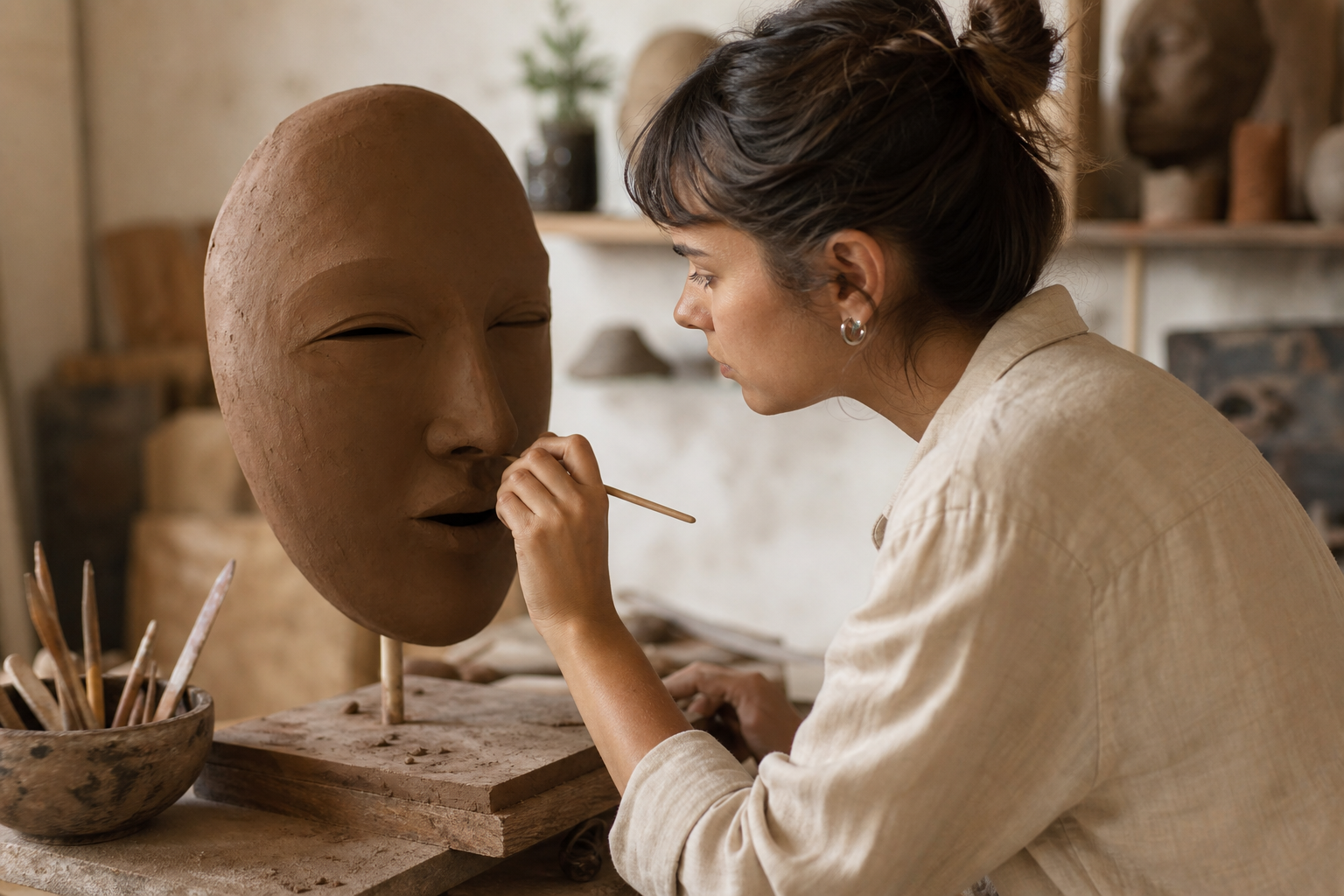
A mask can be technically well resolved and, even so, still feel cold or unconvincing. The difference between a correct piece and one with presence often lies in expressiveness. And expressiveness does not appear by chance: it is built through very specific decisions during the modeling process.
If you are learning how to model a clay mask, it is worth looking beyond “well placed” features. The useful question is not only whether the eyes, nose, or mouth are in the right place, but what overall feeling the piece conveys. Is there tension? Calm? Hardness? Fragility? Mystery?
In a mask, every plane matters. The tilt of an eyebrow, the depth of an eye socket, or the softness of a cheek can completely change how the face is read. That is why, before getting into detail, it is worth working with intention from the overall form.
1. Start with the energy of the mask, not with the details
One of the most common mistakes is to get into the eyes, nose, or mouth too early. Before that, the mask needs a clear structure. Ask yourself what attitude it should have: frontality, serenity, tension, asymmetry, hardness, or delicacy.
When you define that energy from the beginning, the details stop being isolated additions and become part of a shared visual language. The piece gains coherence and avoids that “stuck on” look that sometimes appears when each part seems built separately.
2. Use symmetry as a starting point, not as a destination
Symmetry provides stability, but a completely rigid mask can feel lifeless. Working from a balanced base is useful, especially at the beginning, but it is important to introduce small variations so the face can breathe.
One side can be slightly more tense than the other. One eyebrow can open the gaze more. The upper lip can have a firmer gesture in one area than in another. These nuances, if thoughtfully handled, add humanity and avoid the feeling of a mechanical mold.
This is not about distorting for the sake of distortion. It is about introducing intention. Well-measured asymmetry makes the mask feel inhabited.
3. Pay attention to the transitions between volumes
Expressiveness lives not only in the features, but also in how they connect to one another. A forehead that is too flat, a nose that is too isolated, or cheeks without transitions can interrupt the reading of the face.
Work on the joins calmly. Observe how one form emerges from another. The area between the eyes and the nose, for example, can strengthen the tension of the gaze or soften it depending on the treatment of the planes. The same applies to the relationship between cheekbones, mouth, and jaw.
When the transitions are well resolved, the light moves more effectively across the surface and the mask gains depth. That visual depth is one of the keys to an expressive piece.
4. Never underestimate the weight of the gaze
In a mask, the eyes are often the emotional center. Even when they are closed, simplified, or stylized, they need to be built with precision. The direction of the eye sockets, the thickness of the eyelids, and the openness of the eye area all strongly influence the final character.
A very open gaze can convey surprise, vulnerability, or alertness. A more closed gaze can suggest introspection, mystery, or serenity. Changing the tilt of an eyelid by just a few millimeters can completely alter how the piece is read.
That is why it is worth revisiting this area several times during the process. Often, a mask only starts to truly work when the gaze finds its intention.
5. Think of the surface as part of the message
Texture also speaks. A very polished surface conveys a different feeling from one that is more marked or shows visible working traces. Both options can work, but they must respond to the overall idea of the mask.
If you are aiming for a calmer character, a cleaner surface can help. If you want a more intense or more organic presence, modeling marks can bring it to life. The important thing is that the texture does not seem accidental, but chosen.
Even small tool marks can add expressiveness if they are placed with purpose. The surface is not just finishing; it is also language.
A simple checklist for reviewing your piece
When you finish a stage of the modeling, step back and look at the mask as if it were not yours. That gesture helps a lot. Ask yourself whether the face communicates a clear idea, whether there are areas that are too flat, or whether any part is competing with another unnecessarily.
You can also focus on three basic aspects: rhythm, balance, and focus. Rhythm refers to how the volumes repeat and alternate. Balance refers to how the parts of the face coexist. And focus refers to where the viewer’s eye goes first.
If those three elements work, the mask usually gains a lot of strength, even if it is not completely finished yet.
Conclusion
Modeling a clay mask expressively is not about doing more things, but about making better decisions. The overall energy, the relationship between symmetry and variation, the quality of the transitions, the construction of the gaze, and the treatment of the surface are five points that can transform an ordinary piece into a work with character.
The good news is that these keys can be trained. The more you observe and the more consciously you model, the easier it becomes to decide what each face needs. And that is where true learning begins: when form stops being only technical and starts to communicate.