The mask is one of the oldest and most evocative forms in the history of sculpture. Although it is often associated with theatre or popular celebrations, its presence goes far beyond those functions. Since ancient times, the mask has served to transform the face, represent invisible forces, accompany rituals, and construct symbolic identities. In the history of sculpture, studying the mask means entering a territory where matter, body, and meaning meet in a very direct way.
Its appeal to students and artists is obvious: the mask forces us to think about volume, symmetry, expression, and the relationship between surface and form. But it also speaks to us about culture, belief systems, and how societies have used the image of the face to express things that could not always be put into words.
Ritual and symbolic origins
The earliest known masks are linked to ritual, funerary, and ceremonial practices. In many ancient contexts, covering the face did not mean hiding it, but expanding it: the person wearing the mask ceased to be only an individual and came to embody a different presence, often sacred, protective, or connected to the ancestors.
In this sense, the mask should not be understood merely as a decorative object. Its main function was symbolic. It could mediate between the human and spiritual worlds, mark changes of state, or indicate membership in a group. For that reason, its form was often especially clear and recognizable: oversized eyes, simplified features, marked surfaces, or materials that reinforced its extraordinary character.
The mask in ancient and classical sculpture
In ancient civilizations, the mask took on many different uses. In some cases, it was linked to cult rituals; in others, to ceremonies of power or to theatre. In the Greek world, for example, the mask played a decisive role in stage performance. It made it possible to amplify gesture, distinguish characters, and build types that the audience could easily recognize.
Later, in funerary traditions from different cultures, the mask also functioned as a substitute for the face of the deceased or as a symbolic means of preserving identity. In these cases, sculpture came closer to memory: modeling a face was equivalent to fixing a presence, giving material permanence to something as fragile as human appearance.
From ceremonial object to artistic language
As centuries passed, the mask no longer belonged exclusively to the ritual sphere and also began to attract interest as an autonomous artistic form. Its expressive force made it an ideal piece for experimenting with distortion, abstraction, and drama. Compared with full-figure sculpture, the mask concentrates all its intensity in one part of the body: the face.
That focus is very powerful because the face is where we usually read identity. By isolating it, the mask allows for ambiguity. It can seem human and, at the same time, strange; it can move closer to portraiture or move away from it; it can show emotion or conceal it. That tension has fascinated sculptors across many periods.
The mask in modern sculpture
In modern sculpture, the mask became a particularly fertile source of inspiration. Artists began to value its ability to break with academic naturalism and open up new paths of expression. The simplification of forms, the exaggeration of volumes, and the importance of texture made it useful for exploring a more direct and more symbolic language.
In addition, the mask introduced a reflection on identity. Instead of presenting a faithful portrait, it proposed a constructed presence. That made it especially interesting at a historical moment when sculpture was seeking new ways to represent the human being without limiting itself to copying external appearance.
Materials, technique, and visual reading
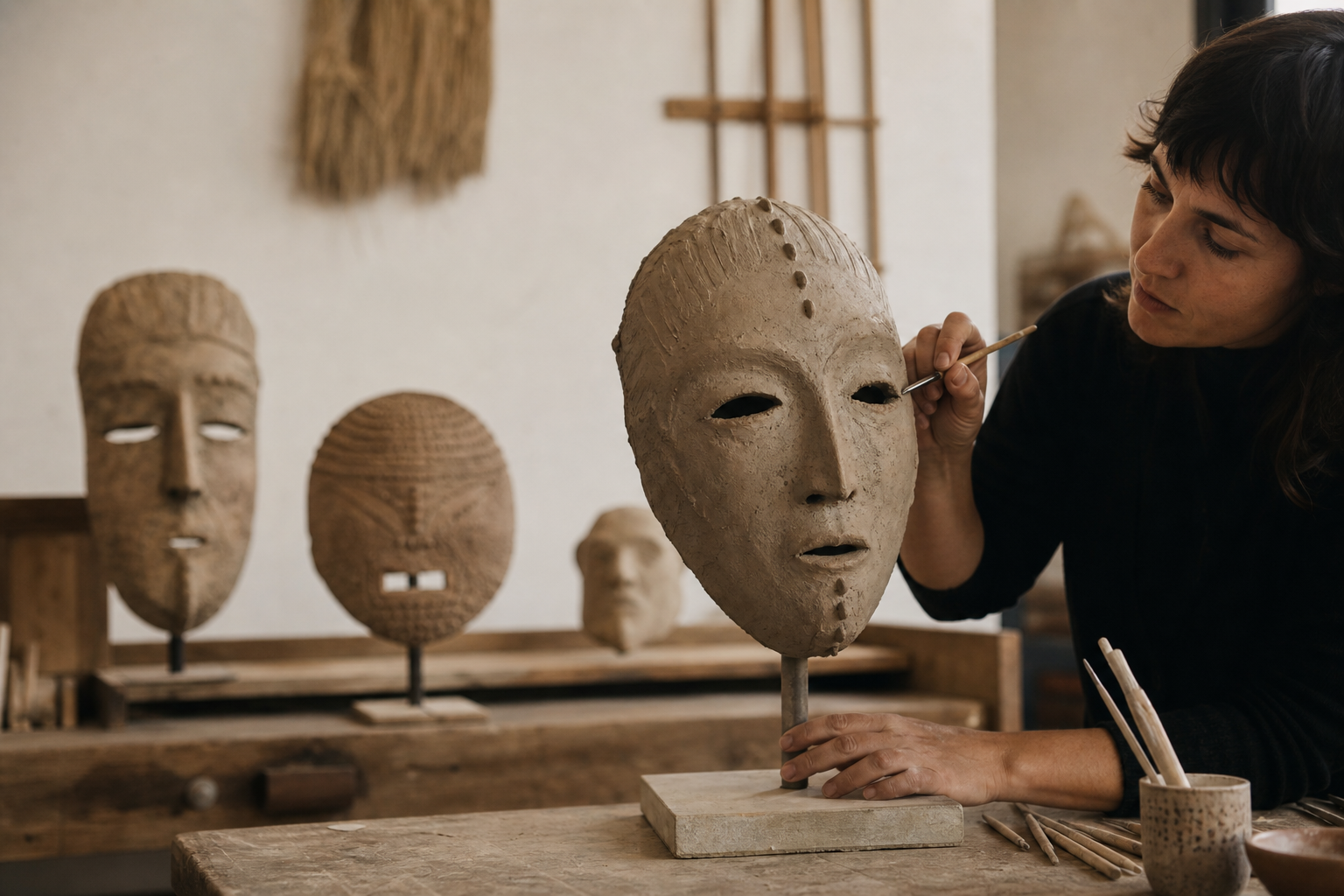
From a technical point of view, the mask is an excellent sculptural exercise because it brings together several important decisions at once. The artist must resolve the overall shape of the face, the thickness of the volume, the relationship between recesses and projections, and the surface as well. A mask may be smooth, rough, polished, aged, or polychromed; each finish completely changes how it is read.
The choice of material also plays a decisive role. Clay, plaster, wood, metal, resin, or plant fibers produce different effects and shape the final expressiveness. In sculptural practice, this variety makes it possible to experiment with lightness, resistance, or the hand-made trace, something especially useful for those who are beginning to model.
What to observe when studying a mask
- The symmetry or asymmetry of the face.
- The relationship between the eyes, nose, and mouth.
- The treatment of the surface.
- The visual weight of the volumes.
- The emotional sensation it conveys.
The mask in contemporary art
Today the mask remains a very alive motif in contemporary sculpture. It appears in works that speak about identity, transformation, memory, gender, or cultural belonging. It is also used to explore the boundary between real face and constructed face, between presence and representation. In many cases, the mask is no longer understood only as an object, but as an idea: something that reveals as much as it conceals.
For that reason, its study remains relevant. The mask makes it possible to see how sculpture can be form, symbol, and experience at the same time. And it offers a very valuable lesson for any student: in art, it is not always necessary to represent the whole body in order to speak about the human condition. Sometimes, a single face built with intention is enough to contain an entire story.
Conclusion
The history of the mask in sculpture shows that artistic objects are not made only to be contemplated, but also to act on those who look at them or use them. From its ritual origins to its presence in contemporary art, the mask has been an instrument of transformation, expression, and knowledge.
For anyone studying sculpture, understanding it is useful from both a historical and a technical point of view. It requires us to think about volume, simplified anatomy, texture, and meaning. And above all, it reminds us that a sculptural piece can be small in size and enormous in symbolic power.