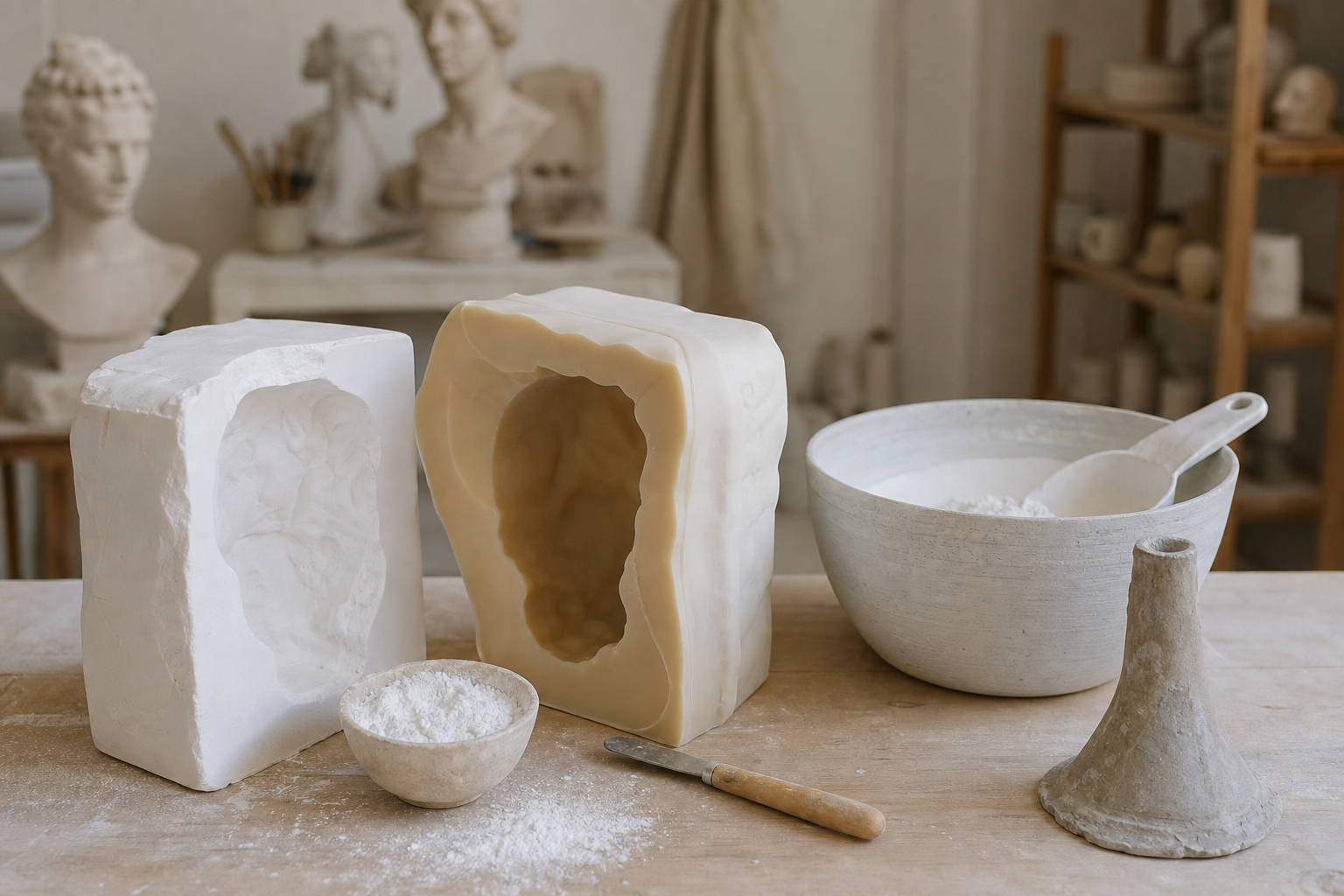
When working with a silicone mold and a plaster mother mold, choosing the right plaster is not a minor detail. It affects the final thickness, the rigidity of the set, the ease of demoulding, and how comfortable the process is during casting or reproducing the piece. That is why, before preparing layers and starting to build the mother mold, it is worth being clear about what we want from that material.
In the context of the course CREATION OF A SILICONE MOLD WITH A PLASTER MOTHER MOLD, plaster has a very specific role: to provide support for the silicone so the mold keeps its shape, can be handled safely, and keeps the piece stable throughout the work. It is not simply about “using plaster,” but about understanding how that material will behave within a flexible mold system.
What plaster should provide in a mother mold
The plaster mother mold acts as a rigid shell that wraps around the silicone mold. Its main purpose is to support it and prevent deformation, especially when the piece is large, has delicate areas, or presents some complexity in opening and closing.
That is why, when choosing the plaster, it is important to consider three aspects:
- Enough strength to withstand repeated use.
- Good workability so layers can be applied without complications.
- A reasonable setting time so the necessary thickness can be shaped without excessive rush.
If the plaster is too fragile, the mother mold may crack or lose stability. If, on the other hand, it sets too quickly, it will be harder to build a clean, well-finished set.
The importance of thickness and layers
In this type of work, plaster is not applied as a single block from the start. The usual approach is to build the mother mold in layers, making sure each one adds strength without unnecessary weight. This approach makes it easier to control the result and adapt the thickness to the shape of the original piece.
A mother mold that is too thin may flex and not protect the silicone properly. One that is excessively thick, however, can be awkward to handle and heavier than necessary. Finding the balance is part of the practical learning process.
So rather than looking for “the strongest plaster,” it is better to choose one that adapts well to the working method and allows you to build a stable, continuous mother mold that is comfortable to use.
What to consider before mixing
Before preparing the plaster, it is useful to check the overall condition of the job. The silicone mold surface should be clean, properly seated, and protected as appropriate. It is also advisable to have the tools organized and to plan the order in which the layers will be applied, because once the mix has been started, working time is limited.
Another important aspect is controlling the water-to-plaster ratio. A correct mix helps produce a homogeneous mass, free of lumps and with better behavior during application. If the mix is too runny, it will lose consistency; if it is too dry, it will be difficult to spread and shape properly.
In practice, this part requires attention and pacing. It is not about rushing, but about working methodically so that each layer settles well on the previous one.
How plaster affects demoulding and casting
The quality of the mother mold directly affects the later stages. A well-made support makes it easier to demould the original piece, reduces the risk of deformation, and helps the mold stay in position when preparing the casting.
In addition, when making the first plaster copy, a stable mother mold provides safety during filling and when removing the piece. This is especially important if you want to check for possible bubbles, clean the copy properly, and let it dry before applying a patina.
In other words, choosing the right plaster does not only improve the mother mold: it also affects the final quality of the reproduction.
Common mistakes when working with plaster
One of the most common mistakes is assuming that any plaster is suitable for any use. In a silicone mother mold, that can lead to fragility, excessive weight, or a surface that is difficult to control.
It is also common to try to solve everything with one thick layer. However, building the set progressively usually gives better results and makes it possible to adjust the volume more precisely.
Another frequent mistake is not respecting the working time of the mix. Rushing too much or trying to touch up the material once it has already started setting can affect the finish quality and the stability of the set.
A practical choice, not just a technical one
Choosing the right plaster for a silicone mother mold is not just about reading a label. It also involves understanding the intended use, the type of piece to be reproduced, and how the mold will be handled throughout the process.
When the plaster is selected and applied with care, the mother mold gains strength, the silicone is well protected, and the subsequent work becomes much smoother. That is precisely the basis of a well-resolved reproduction process: materials that work together and technical decisions that make each step easier.
If you are learning how to build this type of mold, take time to observe how the plaster behaves at each stage. That attention will help you better understand the whole system and achieve cleaner, more stable, and safer results.
In summary: the plaster in the mother mold is not just a support. It is a key part of the system, and choosing it well is one of the decisions that has the greatest influence on the final result.