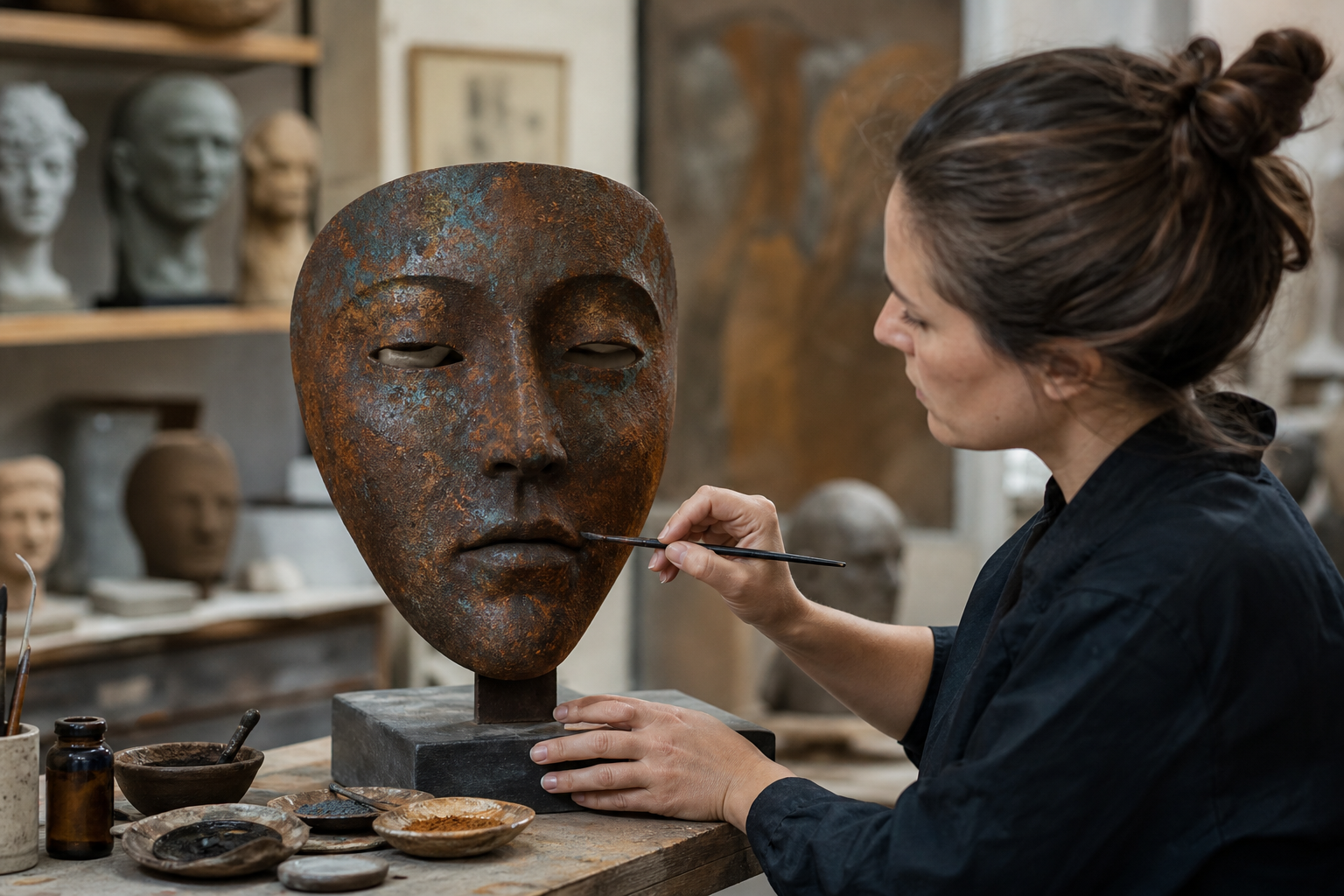
The iron patina with a rust effect is not just a finishing technique: it is a way of interpreting the surface of a piece and giving it a new visual identity. On a mask made of cement, plaster, or resin, this type of treatment turns a neutral support into an object with presence, an implied history, and an aesthetic that sits between the mineral and the metallic. The artistic interest of this approach lies in how colour, texture, and light work together to suggest wear, time, and living matter.
From a formal point of view, this patina works because it does not seek uniformity. On the contrary, it is built on controlled contrasts, transparencies, and small irregularities. That decision is key: the piece stops reading as a closed surface and instead offers visual depth. The result is powerful precisely because it does not seem “finished” in a smooth or polished sense, but inhabited by nuances.
The sealed base as a visual starting point
Before the rust appears, the surface is prepared with shellac. In artistic terms, this step does more than serve a technical sealing function: it also determines how the later layers are received. The prepared base allows the colour to settle in a more controlled way and helps the patina retain a clear reading without losing the desired aging effect.
On a mask, this choice becomes especially important because the sculptural face already contains its own narrative. The prior preparation helps that narrative avoid getting lost under an overly absorbent or irregular application, and instead organises it visually. In this way, the material becomes a more receptive support for later expressive work.
Brown and blue: a combination that creates depth
One of the most interesting aspects of this patina is the dialogue between dark brown and blue. At first glance, it may seem like an unexpected combination for imitating a rusted finish, but that is precisely where its richness lies. Brown provides a warm, earthy, aged base; blue introduces a cool chromatic shadow that cools certain areas and increases the sense of depth.
Artistically, this layering prevents the effect from becoming flat. The colour does not simply cover: it builds volume. The deeper parts, such as the eyes, corners of the mouth, or recesses of the face, can remain darker, while the protruding areas receive greater chromatic presence. That difference makes the mask seem to “breathe” visually and allows the relief to be read more clearly.
The value of irregular application
The dotted brushwork and non-uniform application are essential to this artistic reading. The aim is not to correct every mark, but to use them to generate vibration. When colour settles in small in-and-out motions, the surface stops being simple and begins to suggest a build-up of layers, as if it had passed through time, use, and exposure.
This resource also adds a more expressive dimension. The finish does not merely imitate rusted metal, but a broader idea of transformed matter. The mask acquires an almost archaeological look, as if it had been recovered after a long process of alteration.
The rust effect as texture and as narrative
The rust-effect paint with iron filings introduces the most recognisable gesture of the whole piece: texture. Here we are not talking only about colour, but about a surface that begins to have body. The slight grain adds a tactile sensation that reinforces the rustic and metallic character of the finish.
From an artistic analysis, this final layer is what unifies the visual fiction of the piece. The viewer does not only see ferruginous colour; they perceive an aged materiality, as if time had worked on the object. That nuance matters because rust is not just a decorative effect: it is a sign of transformation, wear, and the passage of time.
Moreover, when applied in specific areas rather than as a total veil, the rust acts as an accent. It highlights protrusions, enhances reliefs, and creates small visual interruptions that animate the reading of the face. The piece gains complexity without losing coherence.
Facial volume and sculptural reading
On a mask, the patina has a special responsibility: it must accompany the anatomy. Forehead, nose, cheekbones, lips, and brows are not just forms; they are tension points where light strikes strongly. That is why this technique works so well on faces: it allows those prominences to be reinforced and the cavities to be deepened with clear logic.
The result is a mask that seems to have been sculpted by colour as well. It is not about painting over the form, but about making its structure visible. In this sense, the patina acts as a second modelling stage. The volume becomes more legible, and the facial gesture gains greater intensity.
A finish between the rustic and the symbolic
The final varnish protects the surface, but it also fixes the aesthetic reading of the whole. Depending on the chosen finish, the piece may move closer to a matte, satin, or glossy presence, although in all cases it retains that blend of restraint and material richness that defines the iron patina.
The most interesting thing about this approach is that it brings together technique and atmosphere. The mask does not only change visually; it also changes in character. It goes from being a support to becoming a piece with a fictional memory, as if it had been found rather than freshly made. That effect is especially valuable in an artistic context because it opens the door to symbolic readings about time, ruin, permanence, and the beauty of erosion.
Ultimately, the iron patina with a rust effect is an ideal technique for those seeking a finish with visual depth and sculptural presence. Its strength lies in the relationship between layers, in the control of volumes, and in the ability to suggest ancient matter without losing formal clarity. It is a highly useful inspiration for exploring how colour can build narrative on a surface.