Choosing the right technique can make a big difference to the final result of a piece. It affects not only the finish, but also the working time, how easy it is to model, the possibility of making corrections, and the type of learning you will gain. That is why, when we talk about sculptural techniques, there is not always a single “best” option in absolute terms: it depends on the goal of the project.
In this comparison, we will focus on three materials and processes that are very common in sculptural work: clay, plaster, and silicone. Each one behaves differently and offers specific possibilities. Understanding those differences will help you make smarter decisions, especially if you are learning or if you are looking to move toward more complex processes.
Clay: the most direct starting point for modelling
Clay is usually the most accessible option when you want to build volume from scratch. Its great advantage is plasticity: it allows you to add, remove, press, smooth, and start again with relative ease. This makes it an ideal material for studying forms, proportions, and expression, especially in pieces such as faces, masks, or small and medium-sized figures.
Another of its strengths is that it encourages very tactile learning. The hand feels the resistance of the material, which helps correct mistakes immediately. In addition, clay invites you to work in stages, without the pressure of a final finish from the very beginning.
Its main limitation is also part of its organic nature: it depends greatly on moisture. If it dries too quickly, it can crack; if it is too soft, it loses definition. For that reason, it requires constant attention and a certain amount of control over the pace of work.
When it makes sense to choose clay
- When you want to learn direct modelling.
- When you need to make frequent corrections.
- When you are looking for an expressive and flexible technique.
- When the project will be a base for a future mould or reproduction.
Plaster: stability, volume, and reproduction
Plaster is not used in the same way as clay. While clay is modelled freely, plaster becomes relevant mainly when the aim is to capture a form, reproduce it, or build a solid structure. In sculptural projects, its value lies in its quick setting time and its ability to produce firm pieces with a good level of detail.
Compared with clay, plaster offers less room for correction once it begins to harden. That is why it requires more planning. It is not the most comfortable technique for improvising, but it is one of the most useful when you already know exactly what you are looking for. It also allows you to create supports, negatives, counter-moulds, and copies, greatly expanding its possibilities.
If clay is a technique of exploration, plaster is closer to construction and production. It is especially interesting in contexts where the stability of the piece matters, or when several versions are needed from one original.
When it makes sense to choose plaster
- When you need a rigid and durable piece.
- When you are going to work with moulds or reproductions.
- When you want to preserve a form with detail.
- When the project requires quick setting and structure.
Silicone: flexibility for moulds and safe demoulding
Silicone occupies a very specific place within sculptural techniques: it is not usually the main material of the final form, but rather the medium used to make flexible moulds. That flexibility is precisely its great strength. It makes it possible to demould pieces with complex details, undercuts, or reliefs without damaging them, something that would be much more difficult with a rigid mould.
Compared with clay and plaster, silicone has a more technical working logic. It requires preparation, application in layers, and careful planning of the process. It is not so much a technique for free modelling as a solution for accurate reproduction. That is why it is often used when the goal is to preserve an original piece and obtain later copies in other materials.
Its biggest advantage is its fidelity to detail and the safety it offers during demoulding. Its main disadvantage is that it needs more preliminary steps and is usually part of a broader system, typically combined with a plaster mother mould or another support structure.
When it makes sense to choose silicone
- When you need a flexible mould.
- When the original piece has many details or protrusions.
- When you want to reduce the risk of breakage during demoulding.
- When the project includes copies or reproductions.
Quick comparison: what each technique brings
In practical terms, clay stands out for modelling freedom; plaster for solidity and construction; and silicone for precision and flexibility in reproduction processes. They do not compete with one another; rather, they often complement each other within the same workflow.
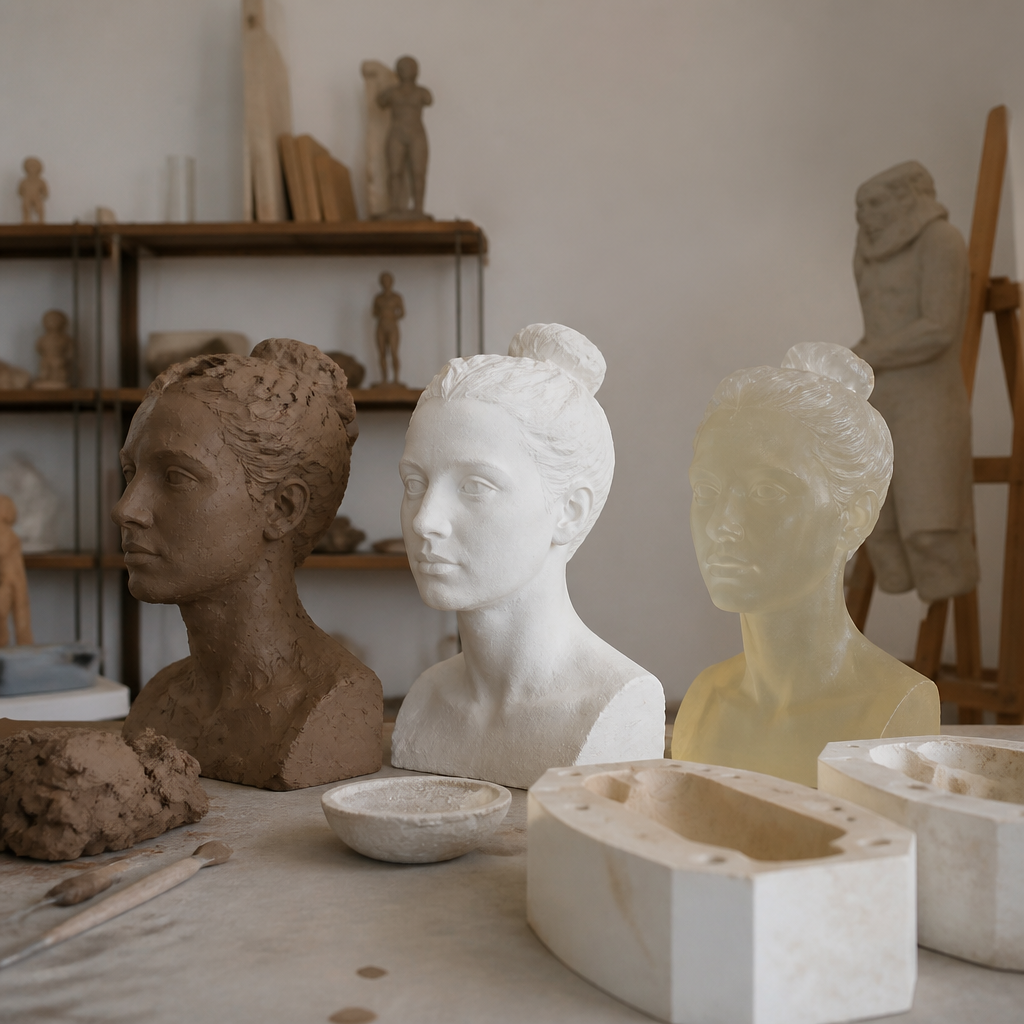
For example, you can model a piece in clay, take a mould with silicone, and reinforce it with plaster in order to produce copies later. In that process, each material serves a different function. Understanding this avoids frustration and allows you to see techniques as tools, not as isolated solutions.
How to decide without overcomplicating things
The best question is not “which technique is the most complete?”, but “what do I need to solve with this piece?”. If you are learning how to shape forms, clay is usually the most educational option. If you want stability or to reproduce a form, plaster takes centre stage. If your goal is to protect an original piece and make copies, silicone becomes almost essential.
It is also worth considering the time available, your level of experience, and the type of result you are aiming for. A very versatile technique may not be the most suitable if you still need control and simplicity. And a more specialised technique can be perfect once you already understand the workflow clearly.
Ultimately, comparing clay, plaster, and silicone is not about choosing a winner, but about learning to recognise the role of each material within the sculptural process. The better you understand that role, the stronger, cleaner, and more coherent your technical decisions will be.
Conclusion: if you want to model freely, start with clay. If you need structure and copies, think about plaster. If the project requires a flexible and precise mould, silicone will be your best ally. The key is to choose the technique according to the intention of the work, not the other way around.