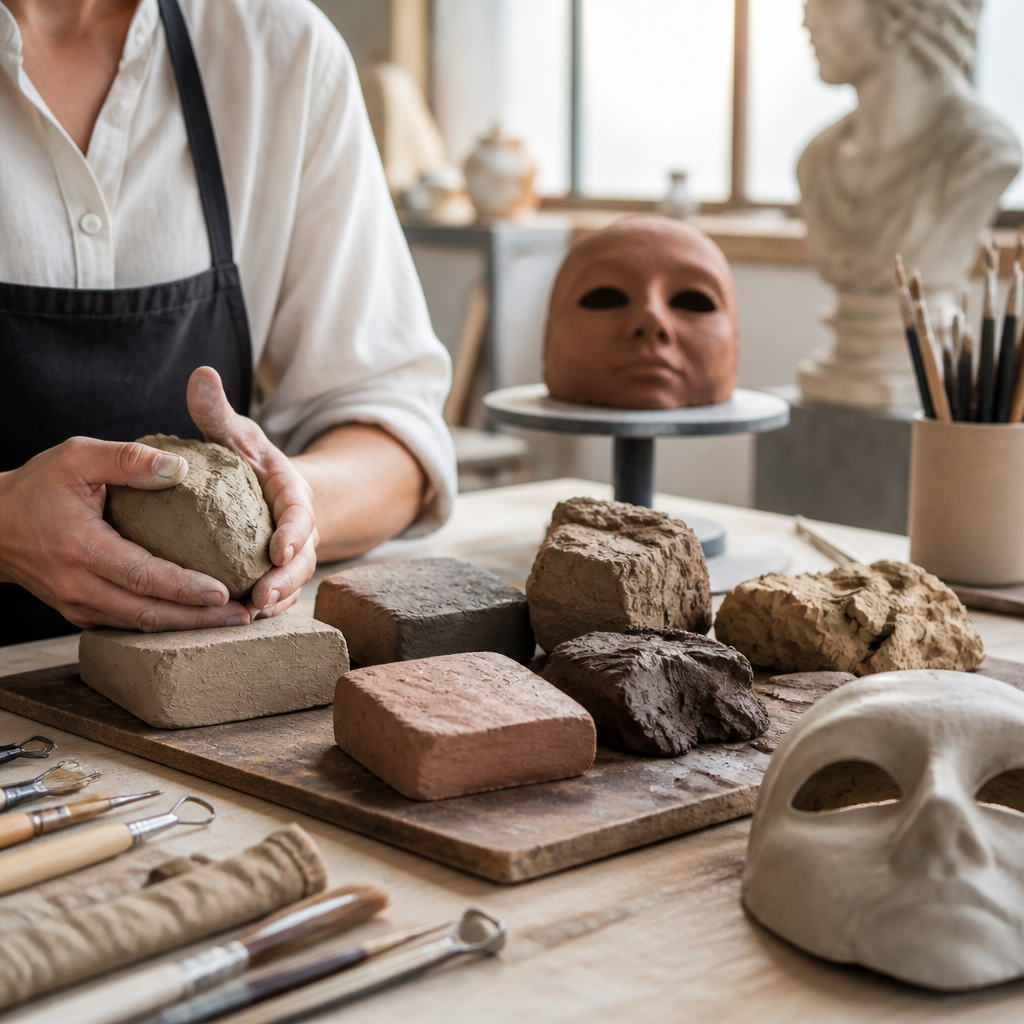
Choosing the right clay for modeling a mask may seem like a simple decision, but in reality it shapes the entire process. The texture, plasticity, drying time, and even the ability to hold detail depend largely on the material you use from the very beginning.
If you are just getting started or want to improve your results, this practical guide will help you understand what to look for in a mask clay, how to assess its characteristics, and which aspects are worth checking before you start modeling.
1. Start by defining what you need for your piece
Not all clays work equally well for every project. Before buying, it is worth thinking about the kind of mask you want to make: more expressive, smoother, with strong relief, or with a surface full of texture.
For facial modeling, it is usually best to choose a clay that lets you add and correct volume easily, does not dry out too quickly, and holds details well in areas such as the eyebrows, nose, lips, or cheekbones.
You should also be clear about whether you will work on the piece in a single session or over several sessions. The more time you need to develop the form, the more important it is that the clay maintains good moisture and a stable consistency.
2. Check three key qualities: plasticity, body, and drying
Plasticity
Plasticity is the clay’s ability to deform without breaking. A very plastic clay adapts well to hand modeling and makes it easier to join small additions of material. For a mask, this quality is especially useful when you are gradually building facial features.
Body
The body of the clay refers to its consistency. If it is too soft, it may sag or lose definition. If it is too hard, it becomes difficult to shape and the transitions in the face look harsher. The ideal choice is a balance that allows you to work volumes and details without constantly fighting the material.
Drying
Drying too quickly can cause cracks, stress, and warping. That is why, for a mask, it is usually best to choose a clay that gives you time to work calmly. If the climate is dry or you work in a very well-ventilated space, this point becomes even more important.
3. Make sure the clay suits facial modeling
Modeling a mask is not the same as creating an abstract form. The face has delicate areas that require precision and a material that responds well to changes in plane. You need to be able to refine the lips, hollow out the eye sockets, lift the brows, and adjust symmetry without the surface tearing or dragging.
For that reason, a clay that is too sandy can make fine finishing difficult, while one that is too soft can cause the piece to lose sharpness. The best choice is usually the one that lets you combine broad masses and expressive detail with control.
4. Do a small test before buying in large quantities
If you are unsure between several clays, the smartest option is to test a sample before committing to a larger amount. A short trial will show whether the material suits the way you work.
Observe how it responds when kneaded, whether it keeps its moisture for a reasonable amount of time, and whether it holds modeling marks well. It is also useful to see how it behaves when joining small pieces, because in a mask many corrections are made precisely by adding material.
That test will save you frustration and give you real information, not just theory.
5. Consider the final finish you want
The clay also affects the final finish of the mask. If you want a very polished surface, it is best to work with a material that accepts refinement well. If you prefer a more expressive or textured look, you can choose a clay that shows the tool and the hand of the modeler more clearly.
Also think about what will happen to the piece afterward. If the mask will dry, be fired, or serve as the base for a mold, the clay choice should align with that goal. A material that looks beautiful when fresh is not always the most practical for the next stage.
6. Avoid the most common mistakes when choosing clay
- Choosing clay based only on price and not on performance.
- Buying a large quantity without testing it first.
- Not considering workshop humidity or working time.
- Using a clay that is too soft for a mask with a lot of detail.
- Ignoring whether the material will be compatible with the next stage of the process.
These mistakes are common because, at first, it is easy to assume that any clay will do. But in a facial piece, where every change of plane matters, the right material makes the process much easier.
Conclusion
Choosing the right clay for modeling a mask does not depend on a single characteristic, but on the balance between plasticity, body, drying, and response to detail. If you define your project clearly, test before you buy, and observe how the material behaves in your hands, you will have a much better chance of achieving a clean, expressive, and well-resolved piece.
The good news is that this decision gets easier with practice. The more you model, the easier it becomes to recognize which clay suits your way of working and the result you are aiming for.